How can we reduce tensions during ICE operations in Minnesota?

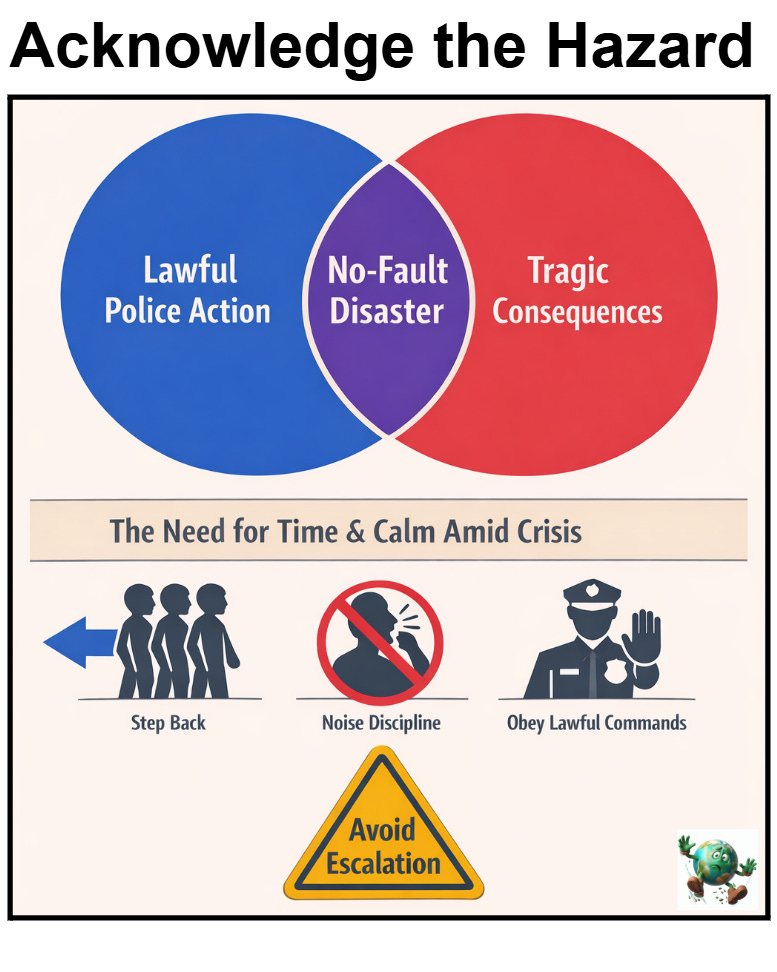
There is a danger zone that rarely gets acknowledged in public debate: the overlap between lawful police action and tragic consequences. It exists not because someone necessarily acted in bad faith, but because human decision-making degrades when time, space, and clarity are compressed. That overlap is where tragedy becomes possible—even when everyone involved is operating within the bounds of the law.
The only reliable way to reduce the size of that danger zone is to preserve what might be called a buffer: distance, time, and the ability to communicate clearly. Police establishing perimeters and moving people away from an unfolding situation is not merely about control or optics. It is an attempt to restore decision-making margins—to slow events down, widen space, and reduce ambiguity before irreversible choices are forced.
This is where crowd dynamics matter, even when individual actions are lawful. Shouting, screaming, banging drums, or blowing whistles may be protected speech, but collectively they raise stress levels and degrade communication. In a noisy, chaotic environment, critical information can be distorted. A shouted warning of “gun” meant to alert officers to a possible threat can be misheard as confirmation of an immediate one—especially by officers who cannot independently verify what the speaker sees. That is not malice; it is signal loss under stress.
When bystanders refuse lawful orders to move back, or physically crowd officers, the buffer collapses further. Even when such behavior is rarely prosecuted, it increases tension, narrows space, and forces officers to divide attention between multiple potential threats. Each contraction of the buffer expands the overlap where lawful actions can still produce catastrophic outcomes.
Importantly, this is not a one-way street. Officers operate under real personal risk in these moments, and the law recognizes that harm does not always result in criminal liability on either side. Just as an officer may lawfully use force with tragic consequences and face no criminal charges, an officer may also be injured by a civilian and yet no charges follow—such as when the civilian was acting under medical delirium or concussion and lacked intent or awareness. In both cases, the legal system separates outcome from culpability.
That symmetry matters. It shows that the buffer is not about assigning blame after the fact, but about preventing harm before it occurs. Without it, civilians face the risk of lawful force applied under extreme uncertainty, and officers face the risk of serious injury with no corresponding criminal accountability on the other side. Once the buffer collapses, the law often arrives too late to protect anyone.
This is why blunt warnings from public officials—that physically confronting officers is a recipe for disaster—are often misunderstood. When Tom Homan said there would be bloodshed, the point was not threat or inevitability. It was a plain description of what happens when distance, time, and clarity disappear. Chaos does not require bad actors to become deadly. It only requires lawful actors forced to decide too fast, with too little information, and no room for error.
If the goal is fewer tragic names—civilian or police—then the focus must be on preserving the buffer, not daring it to collapse.